
How to Choose a Peptides Blog You Can Trust: A Holistic Reader’s Guide to Peptide Research
How to choose a peptides blog you can trust: the source ladder, evidence stages, FDA vocabulary, red flags, and a mindful way to read peptide news before talking to a clinician.

The short version: a peptides blog is worth your time when it links to the original study or FDA record, says plainly whether the evidence comes from cells, animals or people, and does not sell the products it writes about. If a site cannot show you where a claim came from, treat the claim as unproven. The Peptides Blog is one independent example built around those habits.
Peptides have drifted into wellness conversations the same way turmeric and magnesium did a few years ago. Someone at a yoga studio mentions one. A podcast guest swears by another. A friend forwards a short video with a dramatic before-and-after. Before long, people who came to holistic living for slower, more grounded choices find themselves reading product pages written in the language of a pharmacology lecture.
This guide is for that moment. It is not a buying guide and it will not tell you which peptide to try. Instead, it walks through how to choose a peptides blog you can actually trust, how to read what it tells you, and how to carry that information into a calm conversation with a clinician. The goal is the same one behind most good wellness practice: fewer impulsive decisions, more informed ones.
What Peptides Are, in Plain Terms
A peptide is a short chain of amino acids, the same building blocks that make up proteins. When the chain gets long enough and folds into a stable shape, scientists usually call it a protein instead. The line between the two is a convention rather than a hard wall, which is one reason the word “peptide” gets stretched to cover so many different things online.
Your body makes peptides all the time. Some act as hormones and carry signals from one organ to another. Others are fragments left over when you digest the protein in your food. Medicine has also turned certain peptides into approved drugs. Insulin is a peptide hormone, and newer medicines such as semaglutide and tirzepatide are peptide-based drugs that the U.S. Food and Drug Administration has approved for specific uses after clinical trials.
That last point matters. An approved peptide medicine has gone through a defined process, with a label that lists who it is for, the dose, and the known risks. Many of the peptides discussed in wellness spaces have not been through that process. Some have been studied mostly in laboratory dishes or animals. A trustworthy peptides blog keeps those categories separate instead of letting the credibility of insulin rub off on a compound with almost no human data.
Why a Good Peptides Blog Matters More Than Ever
Search for almost any peptide name and the first page tends to fill with storefronts, ranked lists of vendors, and influencer posts. The Peptides Blog makes this point in its guide to which peptide sources deserve your trust, noting that many results are sales pages wearing the costume of education. That is not unique to peptides, but the stakes are higher here because some of these compounds are injected and many have not been reviewed for safety in people.
The regulatory picture also moves quickly, which makes stale information a real risk. In July 2026, an FDA advisory committee voted to recommend that six peptide substances be added to the list of bulk ingredients that compounding pharmacies may use, and voted against a seventh. Advisory votes are recommendations, not decisions. As of late October 2026, legal analysts at Holland & Knight reported that no peptide had been added to that list, and that an interim access policy for compounding certain peptides had been sent to the White House Office of Management and Budget for review on October 14, 2026 but had not yet been issued. A blog post written in August could already be out of date by November. Good sources date their articles and update them.
For someone living a holistic life, this creates a strange tension. You may value natural approaches, yet the peptide conversation is heavily shaped by regulation, chemistry and clinical trial design. You do not need to become a pharmacologist. You do need a reliable translator.
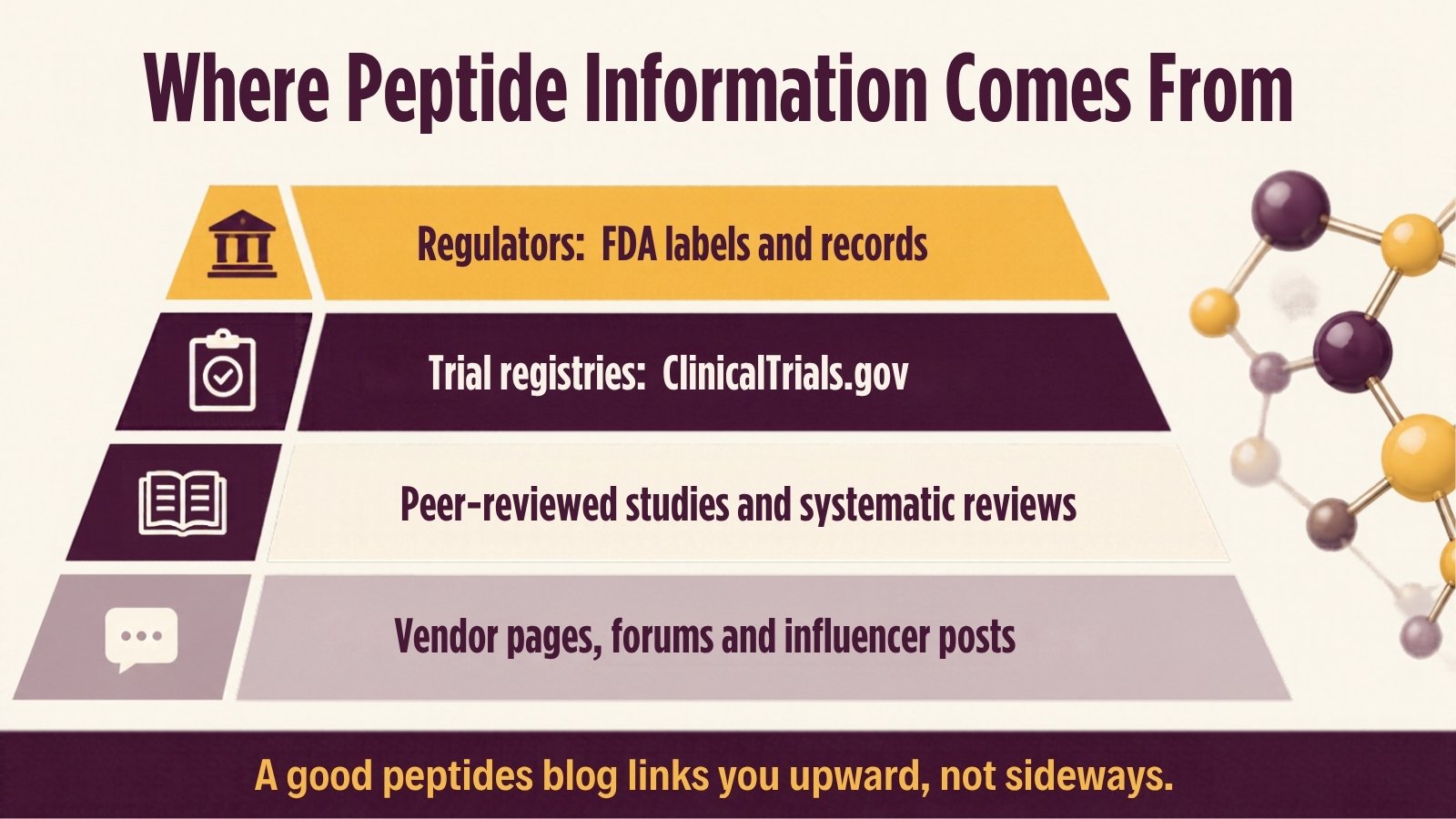
The Source Ladder: Where Reliable Peptide Information Starts
Think of peptide information as a ladder. At the top are regulators, such as FDA drug labels and records. One rung down are clinical trial registries, where researchers describe a study before or while it runs. Below that are peer-reviewed journal articles and systematic reviews that pool several studies together. At the bottom sit vendor websites, forums and influencer content.
The bottom rung is not always wrong. Sometimes a forum post points you to a real study. But information at that level is someone’s interpretation, and often someone’s sales pitch. A trustworthy peptides blog lives in the middle of the ladder. Its job is to climb up for you, read the original material, and bring it back down in language you can use, with links so you can check the climb yourself.
Here is a simple test. Pick any claim in an article and click the link next to it. Does it lead to an FDA page, a ClinicalTrials.gov record, or a journal article? Or does it lead to another blog, a product page, or nowhere at all? If most links point sideways rather than upward, the site is repeating rather than reporting.
Borrowing a Framework From the NIH
You do not have to invent your own checklist. The National Center for Complementary and Integrative Health, part of the National Institutes of Health, launched an initiative called Know the Science in October 2017 to help consumers make sense of health research and health news. It is a natural fit for holistic readers because NCCIH is the federal agency focused on complementary and integrative health.
Its materials encourage a handful of questions that work beautifully for peptide content. Do the claims seem too good to be true? Is the information based on scientific research? Has it been reviewed by people with relevant expertise? How current is it? One of its modules also explains why calling something “natural” does not automatically make it safer or better, a message that applies directly to the many peptide products marketed as natural because similar molecules occur in the body.
Apply those four questions to the next peptide article you read. Most low-quality content fails at least two of them within the first few paragraphs.
Reading the Evidence Without a Science Degree
The single most useful skill for a peptide reader is noticing what kind of study a claim comes from. Research generally moves through stages, and each one answers a different question.
Laboratory studies test a compound on cells in a dish. They can show that a molecule does something interesting, but cells in a dish are not a person. Many compounds that look promising here never work in humans.
Animal studies test a compound in mice, rats or other animals. They tell researchers whether an idea is worth pursuing and give early safety signals. Doses, metabolism and outcomes often differ in people.
Observational human studies watch what happens to people without assigning them a treatment. They can reveal patterns but struggle to prove cause and effect.
Controlled human trials assign people to a treatment or comparison group, ideally at random, and measure defined outcomes. These are the studies regulators rely on most when deciding whether a drug works and is safe enough to approve.
A careful peptides blog labels every claim with its stage. The Peptides Blog’s walkthrough on reading a peptide study like a careful skeptic suggests attaching seven details to any finding before you repeat it: the model, the population, the intervention, the comparison, the outcome measured, the size of the effect, and the limits. When an article skips most of those, it is easy for a result in rat tendons to turn into a promise about your knee.
A small practice: before you share a peptide claim with a friend, say out loud what kind of study it came from. “A study in mice found…” sounds very different from “Peptide X heals injuries.” That one sentence protects both of you.
A Short Lesson on Checking Sources
The video below comes from Crash Course’s series on scientific thinking. It is not about peptides specifically, which is part of its value. It teaches a general method for checking a claim before you believe it, including stopping before you react, looking into who is behind a source, and tracing a claim back to its original context. Those habits transfer directly to peptide content.
The Vocabulary That Separates Medicine From Marketing
Four terms do most of the heavy lifting in peptide discussions, and they are easy to blur together. A reliable peptides blog uses them precisely.
Approved means the FDA has reviewed evidence for a specific drug product and decided it may be marketed for stated uses. Approval belongs to a particular product and use, not to a molecule in every form.
Investigational means a product is being studied, usually in registered clinical trials. It has not been approved for the use being tested.
Compounded means a licensed pharmacist or physician prepared a medication for an individual patient under specific legal provisions. The FDA does not approve compounded preparations, and which bulk ingredients may be used is tightly regulated. The FDA publishes a list of bulk substances nominated for compounding and how each is categorized, which sorts nominations into those under evaluation, those that raise significant safety concerns, and those nominated without adequate support.
“Research only” is labeling and marketing language. The Peptides Blog’s explainer on approved, investigational, compounded and research-only peptides points out that FDA does not treat “research-only” as an approval category. When a website sells a product labeled this way while describing human benefits, that mismatch is itself useful information.
Once you know these four words, many peptide pages start reading differently. A page that calls an unapproved product “clinically proven” or hints that a compounded preparation is “FDA approved” has told you something important about its reliability.
Comparing the Places You Might Read About Peptides
Not every source is trying to do the same job. This table compares common kinds of peptide content on the qualities that matter most to a careful reader.
| Source type | Links to original research | Labels evidence stage | Sells products | Best use |
|---|---|---|---|---|
| FDA labels and records | Is the original record | Describes approved uses and trial data | No | Checking what a medicine is approved for and its warnings |
| ClinicalTrials.gov entries | Is the registry record | Shows study design and status | No | Confirming a trial exists and what it measured |
| Peer-reviewed journal articles | Is the primary research | Yes, in the methods | No | Reading the full details of a single study |
| Independent educational blog | Should, on every claim | Should, clearly | Should not | Plain-language summaries with a path to the sources |
| Vendor or storefront pages | Rarely, often selectively | Rarely | Yes | Product details only, never as evidence |
| Influencer posts and podcasts | Occasionally | Seldom | Often, through affiliate links | Noticing trends to research elsewhere |
The pattern is clear. Sources that sell tend to cite less, and sources that cite more tend to sell nothing. An independent peptides blog earns its place in the middle by behaving like the upper rungs while writing for everyday readers.
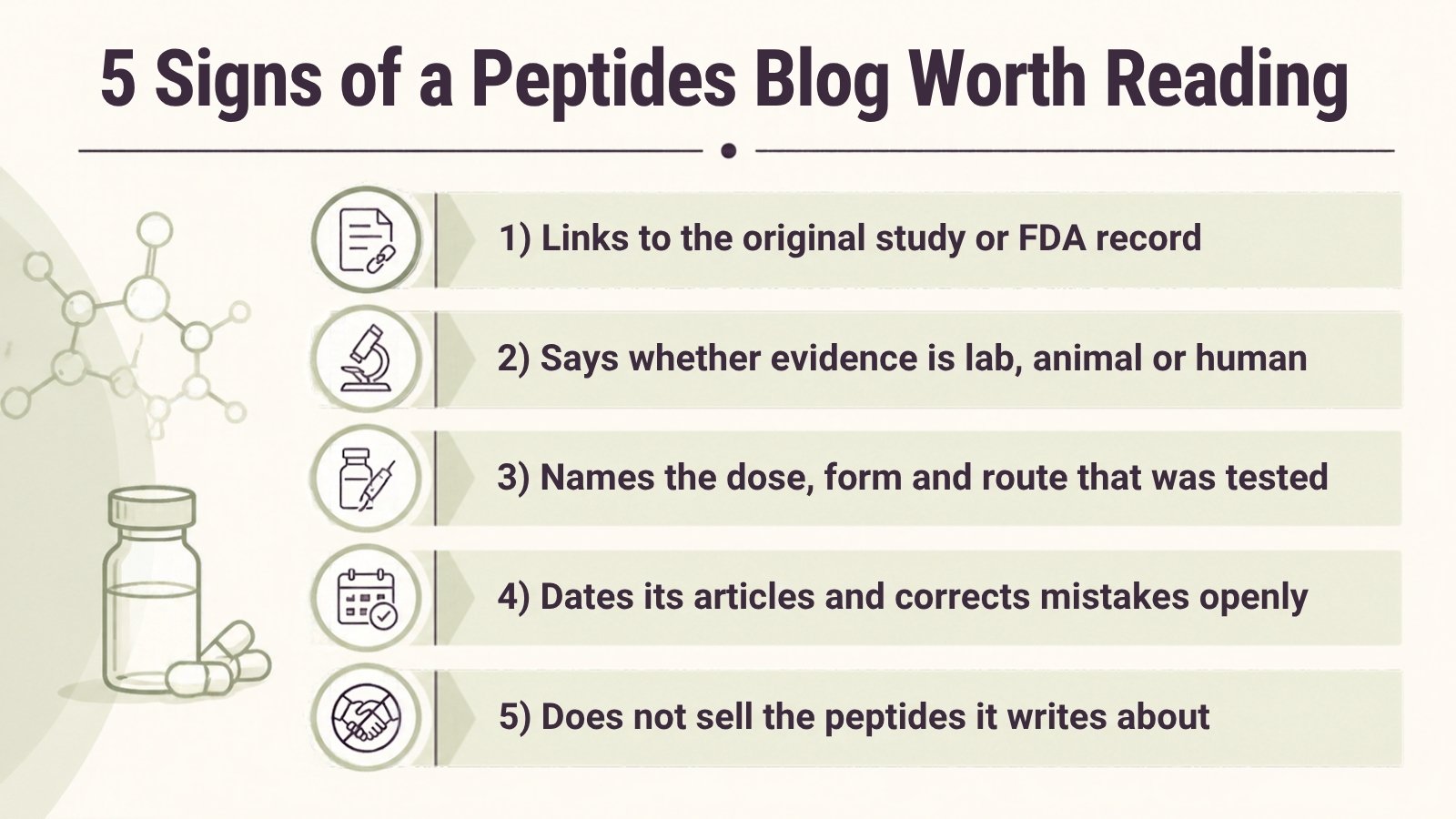
Five Signs of a Peptides Blog Worth Reading
1. It links to the original study or FDA record. Not to another article that summarizes the study, but to the study itself. You should be able to reach the source in one click.
2. It says what kind of evidence it is describing. Lab, animal, observational or controlled human trial. If you cannot tell after reading the section, the writer either did not know or did not want you to know.
3. It names the dose, form and route that was tested. A peptide studied as an injection may behave very differently in a cream or a capsule. Evidence for one form does not automatically carry over to another.
4. It dates its articles and corrects mistakes openly. Peptide regulation changed several times in 2026 alone. Look for publication dates, update notes and a stated corrections policy. The Peptides Blog publishes its editorial standards, which commit to identifying the evidence type, using honest bylines, and dating material corrections.
5. It does not sell the peptides it writes about. An educational site can still be imperfect, but a site that profits from every sale of the product it reviews has a conflict that no disclaimer fully removes.
Red Flags Borrowed From Influencer Culture
Some warning signs show up again and again in peptide marketing. Learning to spot them is faster than fact-checking every claim from scratch.
Watch for timelines that sound miraculous, such as fat melting in weeks or tendons healing in days. Watch for a single compound promised to help with sleep, skin, muscle, mood and longevity all at once. Be cautious when a claim leans on “the body already makes it” as proof of safety. Notice when an affiliate code or discount appears in the same breath as the health claim. And be wary of any post that tells you doctors “don’t want you to know” something, which tends to replace evidence with a story about suspicion.
The Peptides Blog checks six recurring claim types in its review of viral peptide influencer claims against FDA records and trials, and its conclusion is a useful anchor: some peptides have legitimate approved uses, while many circulating claims go well beyond what human research supports.
A Mindful Way to Read Health Content
Here is where holistic practice and evidence-based reading meet. Much of the pull of peptide marketing is emotional. It promises a shortcut to energy, recovery or youth, and it often arrives when you are tired, sore or worried. Recognizing that pull is half the work.
The same present-moment awareness described in our guide to how mindfulness supports a balanced lifestyle works well here. When a peptide post grabs you, pause. Notice the feeling it created, whether hope, urgency or fear of missing out. Then ask what the post actually showed you. Often the honest answer is a strong feeling and very little data.
A simple three-breath routine can help. On the first breath, name the claim in one sentence. On the second, name the source and the kind of study behind it. On the third, decide whether you need to act now or whether this can wait until you have read a reliable summary or spoken with a clinician. Almost nothing in the peptide world requires a same-day decision.
Where The Peptides Blog Fits
If you want a starting point that follows the habits above, The Peptides Blog is an independent educational publication that explains peptide research and links to the underlying studies. It covers topics such as collagen and collagen peptides, GHK-Cu in skin and hair research, and peptide medicines including semaglutide and tirzepatide, with each guide describing the evidence stage and the relevant regulatory status. It does not sell peptides, provide clinical treatment, or offer medical consultations, which keeps the focus on the research rather than a product.
Explore peptide benefits and the research behind them through The Peptides Blog’s evidence-labeled guide library, and use it the way you would use any good secondary source: as a map. Read the summary, then follow at least one link up the ladder to the original record. Over time you will need the map less, because you will recognize the terrain yourself.
Bringing What You Learn to Your Clinician
Reading is the beginning, not the decision. If a peptide topic touches your own health, the most useful next step is a conversation with a licensed clinician who knows your history, your medications and your goals.
Arrive prepared. Write down the claim you read, the source, and the type of study behind it. Ask whether the product in question is approved for your situation, and if not, what is known and unknown about it. Ask how it might interact with anything you already take, including supplements and herbs, since interactions are easy to overlook. If the conversation involves an approved peptide medicine, ask what monitoring would look like and what side effects to watch for.
A good clinician will welcome these questions. Bringing a well-sourced article rather than a screenshot of an influencer post also tends to lead to a more productive conversation.
Building Your Own Short List of Trusted Sources
You do not need dozens of bookmarks. A short, well-chosen list beats an endless feed. NCCIH suggests beginning with organized collections of high-quality resources, and its page on where to start when searching for health information online points readers toward MyHealthfinder, the NCCIH website for complementary approaches, and the NIH Office of Dietary Supplements.
From there, a practical personal list might include one regulator source for checking approvals, one trial registry for checking whether a study exists, one plain-language peptides blog for summaries, and your own clinician for decisions. That is enough to handle almost any peptide question you will meet.
If you are rethinking how health information fits into a broader wellness practice, our overview of holistic living, mindfulness and balance offers a wider frame for those choices.
Frequently Asked Questions
What should a good peptides blog include?
Links to original studies or FDA records, a clear label for the type of evidence behind each claim, dates on every article, a corrections policy, and no sales of the products it discusses. If several of these are missing, read with extra caution.
Are peptides natural or synthetic?
Both. Your body makes many peptides naturally, and others are manufactured in laboratories for medicines, research or commercial products. A peptide being similar to one in your body does not by itself show that a manufactured product is safe or effective.
Are all peptides approved by the FDA?
No. Some peptide medicines, such as insulin and the GLP-1 drugs semaglutide and tirzepatide, are FDA approved for specific uses. Many peptides promoted online are not approved, and approval for one product and use does not extend to other products or uses.
Does “research use only” mean a peptide is safe for research in people?
No. “Research use only” is labeling and marketing language, not an FDA approval category. It does not indicate that a product has been tested or approved for human use.
How can I check whether a peptide study is real?
Look for a link to the journal article or a ClinicalTrials.gov record. Check who the participants were, whether they were people or animals, what was measured, and how large the effect was. A trustworthy peptides blog will give you that link directly.
Disclaimer: This article is for general education only and is not medical advice, diagnosis or treatment. It does not recommend any peptide, supplement or medication, and nothing here should be read as a claim that any product prevents, treats or cures a condition. Regulatory status for peptides can change quickly, so confirm current information with the FDA and a licensed healthcare professional before acting. Talk with your clinician before starting, stopping or changing any medicine or supplement. Mala Wellness Collective is not affiliated with, and does not receive payment from, any peptide manufacturer or seller.

Freddie Brewer
More articles by this author